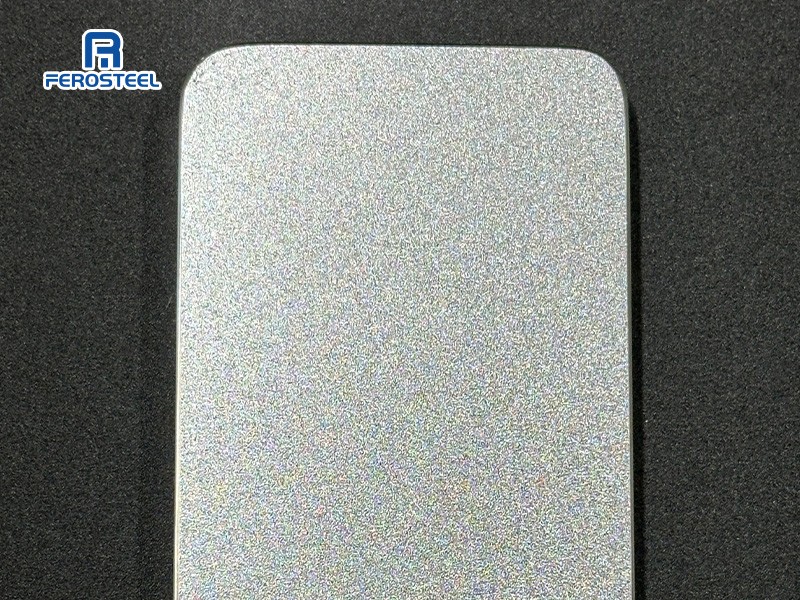
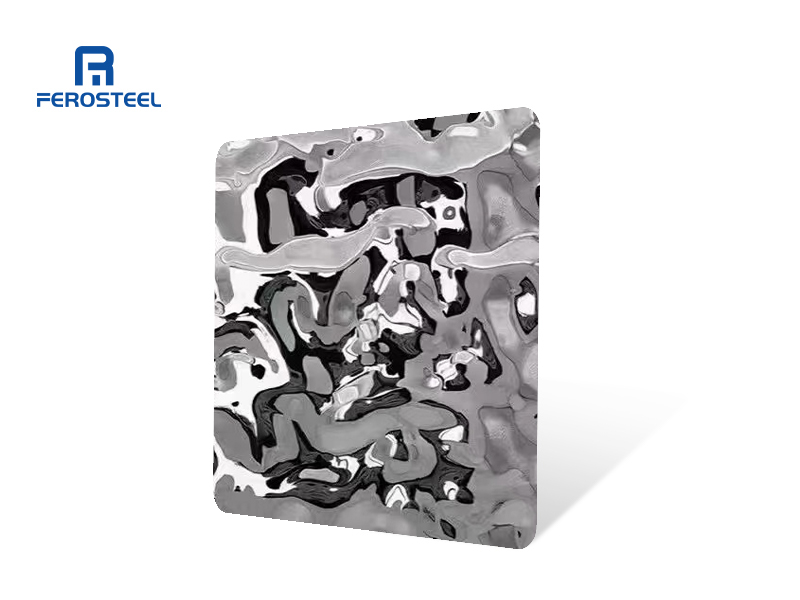
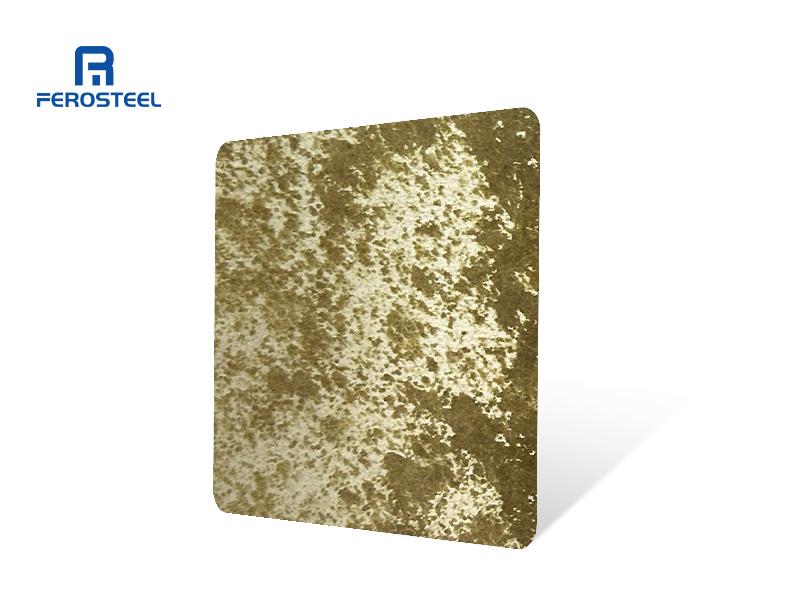
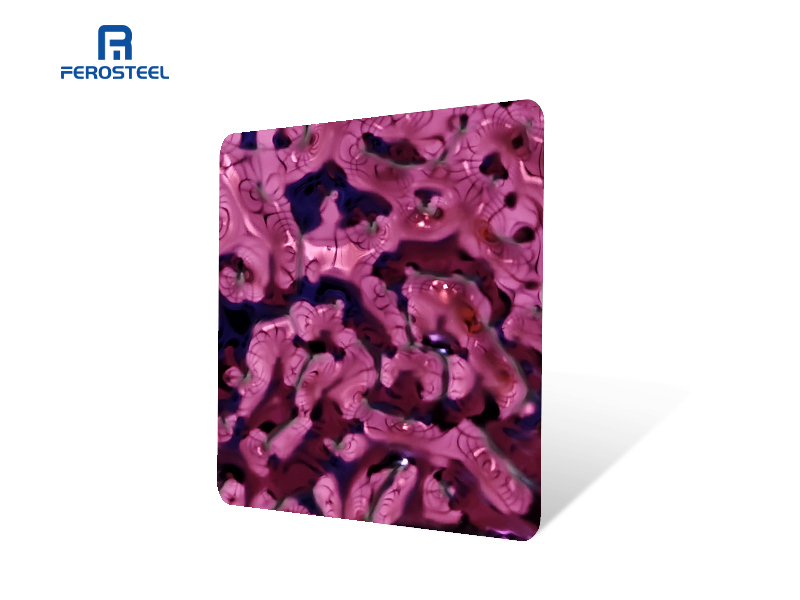
This guide walks through how each surface is actually made, how to write them into a 2026 specification, what they really cost, and where each one belongs. It is written from the factory side of the table — the details that decide whether a panel project succeeds or quietly overruns.
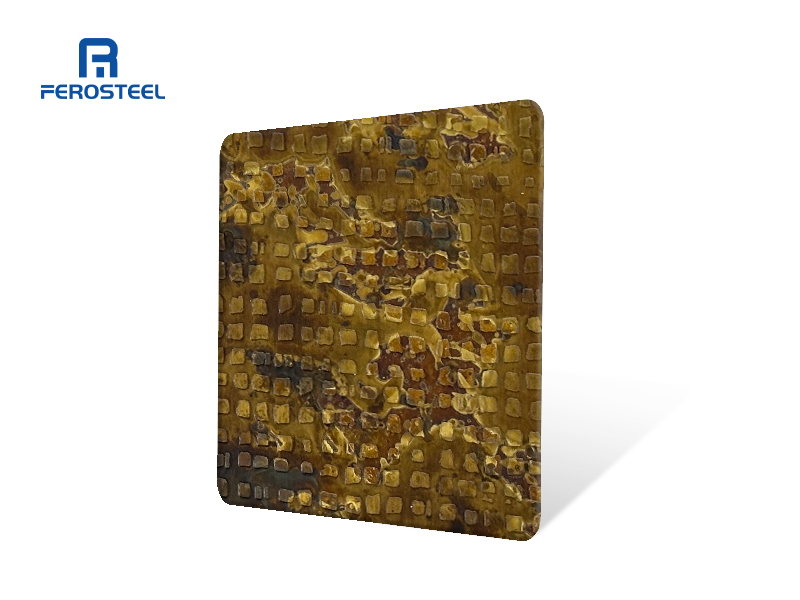
Liquid metal finish. A liquid metal finish stainless steel panel starts as a normal stainless steel sheet, then a metallic art coating is applied by hand in multiple layers. The coating is moved, built up, and shaped into an irregular three-dimensional relief, then sealed with a transparent protective topcoat. There is no fixed geometry and no exact repetition: light falls differently on every raised and recessed area, which creates the shadows, highlights, and sense of movement that make the material feel alive.
Pattern comes first. Color comes second. Most liquid metal surfaces use antique copper, bronze, black-gold, or oxidized metallic tones, but the color only exists to reveal the relief. Darker tones deepen the recessed areas; brighter metallic tones lift the raised ones. Two sheets in the same bronze color can look completely different if the pattern scale, relief, and distribution differ.
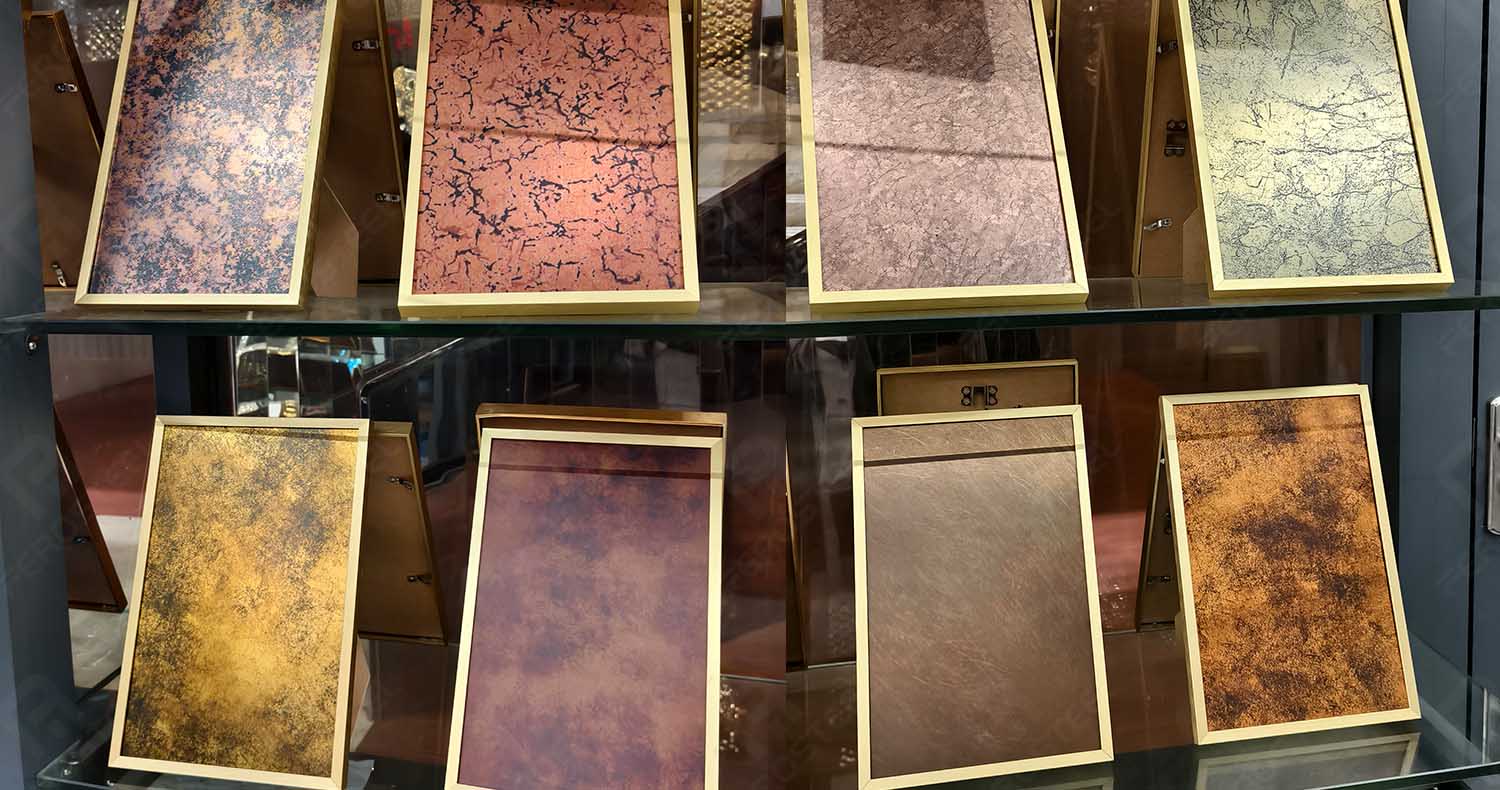
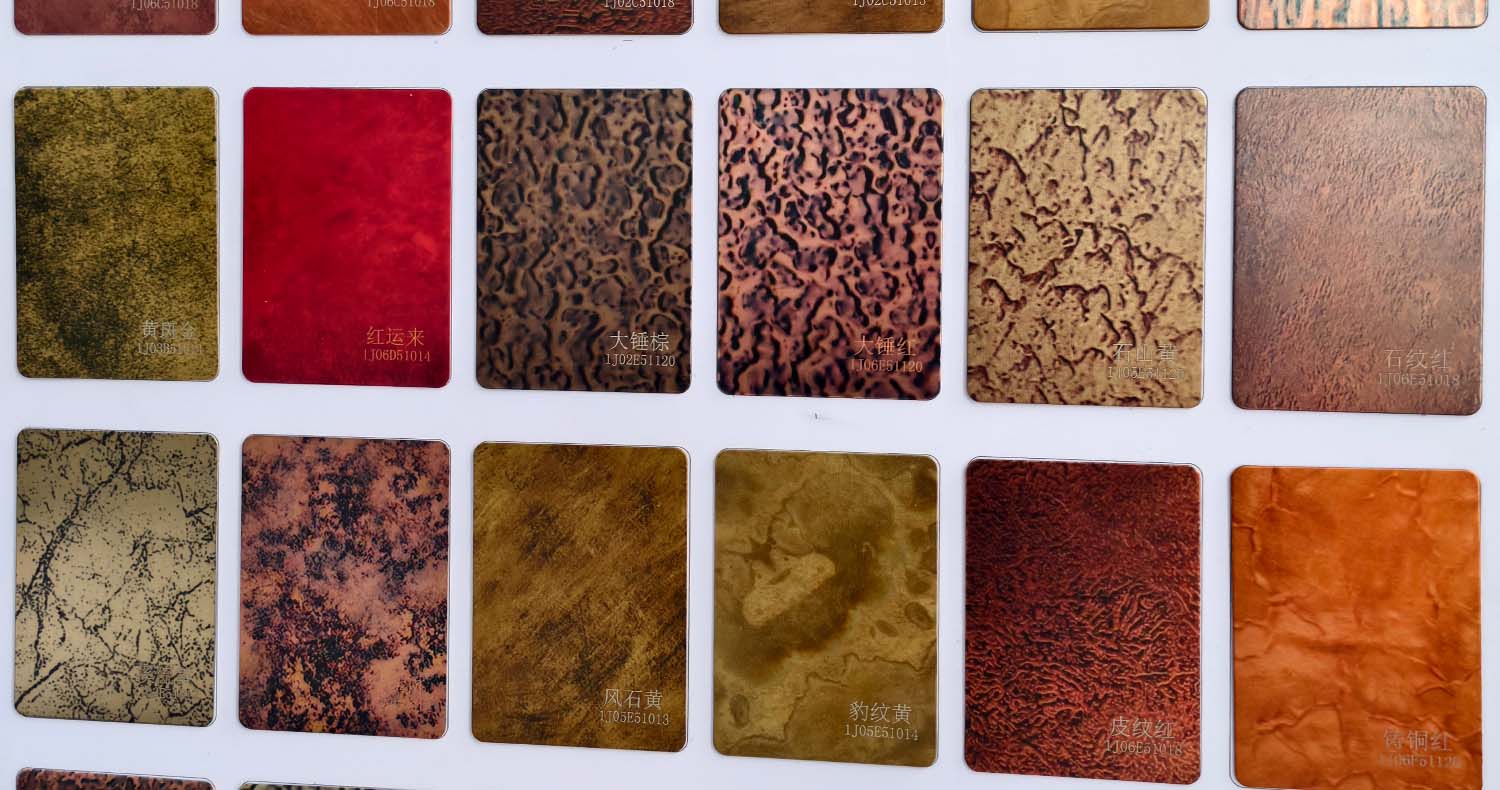
Standard stainless steel panels. In this comparison, a standard panel means a flat or patterned sheet produced with conventional finishing processes. You pick a grade (304, 316, 201, 430), a thickness, and a finish code: 2B, No. 4 brushed, hairline (HL), 8K mirror, bright annealed (BA), PVD color, or a mechanically patterned surface such as water ripple, linen, honeycomb, or embossed.
The defining difference from liquid metal is predictability. Etched sheets are made from artwork, embossed sheets from molds or rollers, and PVD is a coating applied to an established surface. Sheet number fifty looks like sheet number one. That repeatability is exactly what makes standard panels cheaper, faster, and easier to coordinate on large projects.
| Feature | Liquid Metal Finish | Standard Stainless Steel Panel |
|---|---|---|
| Pattern source | Manually shaped during production | Preset artwork, mold, roller, or tooling |
| Pattern style | Irregular, organic, non-repeating | Defined, planned, repeatable |
| Sheet-to-sheet appearance | Each sheet is different within an approved range | Largely consistent |
| Role of color | Supports shadows, highlights, and relief | Enhances an existing regular pattern |
| Main value | Handcrafted individuality | Pattern accuracy and repeatability |
| Best use | High-end customized feature surfaces | Larger areas needing consistency and cost control |
Most specification failures happen before production starts, not during it. Here is what a 2026 specification needs to cover — and where buyers usually get it wrong.
304 is the default for interior decorative panels: good corrosion resistance, good formability, and a reasonable price. 316, with its molybdenum content, earns the premium in coastal or chloride-heavy environments and high-humidity applications. For interior feature walls, 304 at 0.8–1.5 mm is the workhorse; heavier gauges appear where panels must stay dead flat over large spans, and honeycomb composite panels are increasingly specified for big walls to control both flatness and weight. Mill and fabricated sheets are covered by ASTM A240/A480, EN 10088-2, JIS G4304/G4305, or GB/T 3280 — name one standard in the tender and hold the supplier to it.
On size, 1219 × 2438 mm (4 × 8 ft) is the industry default, with 1000 × 2000, 1250 × 2500, and 1500 × 3000 mm common. Anything larger is custom and changes cost, lead time, and panel structure.
With a standard panel, the finish code tells the supplier everything. With liquid metal, a color name tells them almost nothing. Because the pattern is made partly by hand, you control it through six parameters:
Liquid metal costs significantly more than a PVD-colored patterned sheet. The gap is not material cost — it is labor. Expect multi-stage coating, skilled manual shaping, slower production speed, harder visual control, variation between individual panels, more detailed sample approval, and extra layout and inspection work on multi-panel jobs. Every one of those line items shows up on the invoice.
| Cost item (2026) | Typical range, USD | Notes |
|---|---|---|
| Raw stainless sheet | $2.50 – $12 / sq ft | Depends on grade (304/316), thickness, finish |
| Fabrication labor | $1.50 – $8 / sq ft | Cutting, edgework, panel fabrication |
| Conventional surface finish | $0.50 – $4 / sq ft | Brushed, mirror, PVD color |
| Standard cladding, fully installed | $15 – $45 / sq ft | Material plus installation |
| Liquid metal finish application | ≈ $27 – $51 / sq ft | Applied coating only; substrate panel counted separately |
The practical takeaway: on a 50 m² feature wall the difference is a meaningful line item. On a 500 m² lobby it decides the budget. Use liquid metal where the irregular texture is the design — a feature wall, a column, a reception desk — and standard patterned panels everywhere the design needs consistency and cost control.
Both products share the same stainless steel substrate, so the base durability story is identical. The difference is the surface layer. Standard PVD-colored and patterned sheets hold up well in interior service, and anti-fingerprint treatment is now routine on decorative panels. Liquid metal panels carry a transparent protective topcoat; the raised sections take more direct contact than the recesses, so the honest description is durable — not scratch-proof. Handle carefully and clean gently.
A stainless steel base does not automatically make the decorative coating suitable for every environment.
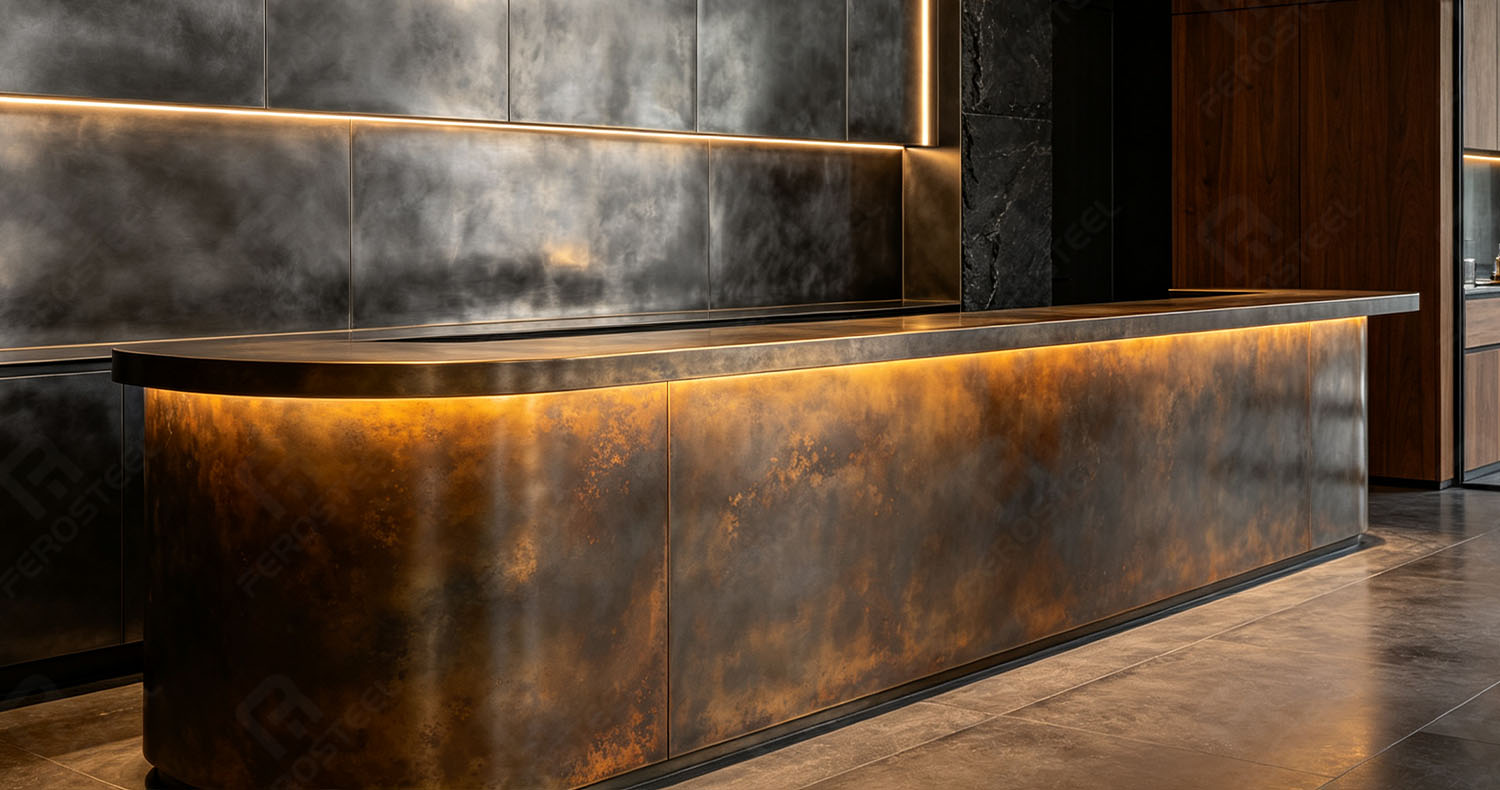
Decorative metal has moved from accent to structure in high-end hospitality. Industry estimates suggest more than 60% of newly opened five-star properties now integrate decorative metal surfaces across lobby, signage, partition, ceiling, and elevator zones. Water ripple is one of the fastest-growing decorative finishes in luxury hospitality, and designers are increasingly pairing aged, "vintage character" surfaces with clean stainless — which is exactly the territory liquid metal occupies. The demand for handcrafted, non-repeating metal surfaces is real and rising. The discipline is knowing when not to specify them.
Three questions settle the decision:
Our honest default: standard stainless steel panels with PVD color or a mechanical pattern for most of the project; liquid metal for the moments that need to be remembered. If you are sourcing for a specific project, send reference images, application, dimensions, quantity, and drawings — that is the only way to judge which surface is the better solution for your wall, not for the category.
For B2B projects, browse the water ripple stainless steel sheets range or PVD coated stainless steel sheets from the manufacturer.
No. The color supports the appearance, but the main feature is the manually created, irregular raised-and-recessed pattern. Two sheets in the same color can look completely different if the relief differs.
Etched stainless steel follows a pre-designed, repeatable pattern, so every sheet matches. Liquid metal finish is shaped manually, so the position, outline, and distribution of the texture change from sheet to sheet within an approved range.
Because of labor: multi-stage coating, skilled manual shaping, slower production, harder visual control, panel-to-panel variation, and more detailed sample approval and inspection.
No, and they should not. Each sheet is different, but pattern scale, relief, density, color balance, and overall character must stay within the approved sample range. Controlled variation is the design; uncontrolled inconsistency is a defect.
Not by default. It is made for curated interior use. Wet environments, high abrasion, aggressive cleaning, and exterior exposure need testing and confirmation first — a stainless steel base does not automatically make the coating suitable everywhere.
304 is the standard choice for interior decorative panels; specify 316 for coastal or chloride-heavy environments. 0.8–1.5 mm is the typical range for wall and column panels, with honeycomb composite construction for very large flat areas.
 Office address: 26 Floor, Shibo Financial Center, Fenjiang South Road No.38, Chancheng, Foshan, GuangDong, China
  Phone
: +86 -18024913898
Phone
: +86 -18024913898 Email
: [email protected]
Email
: [email protected]


 IPv6 network supported
 leave a message