Table of Contents
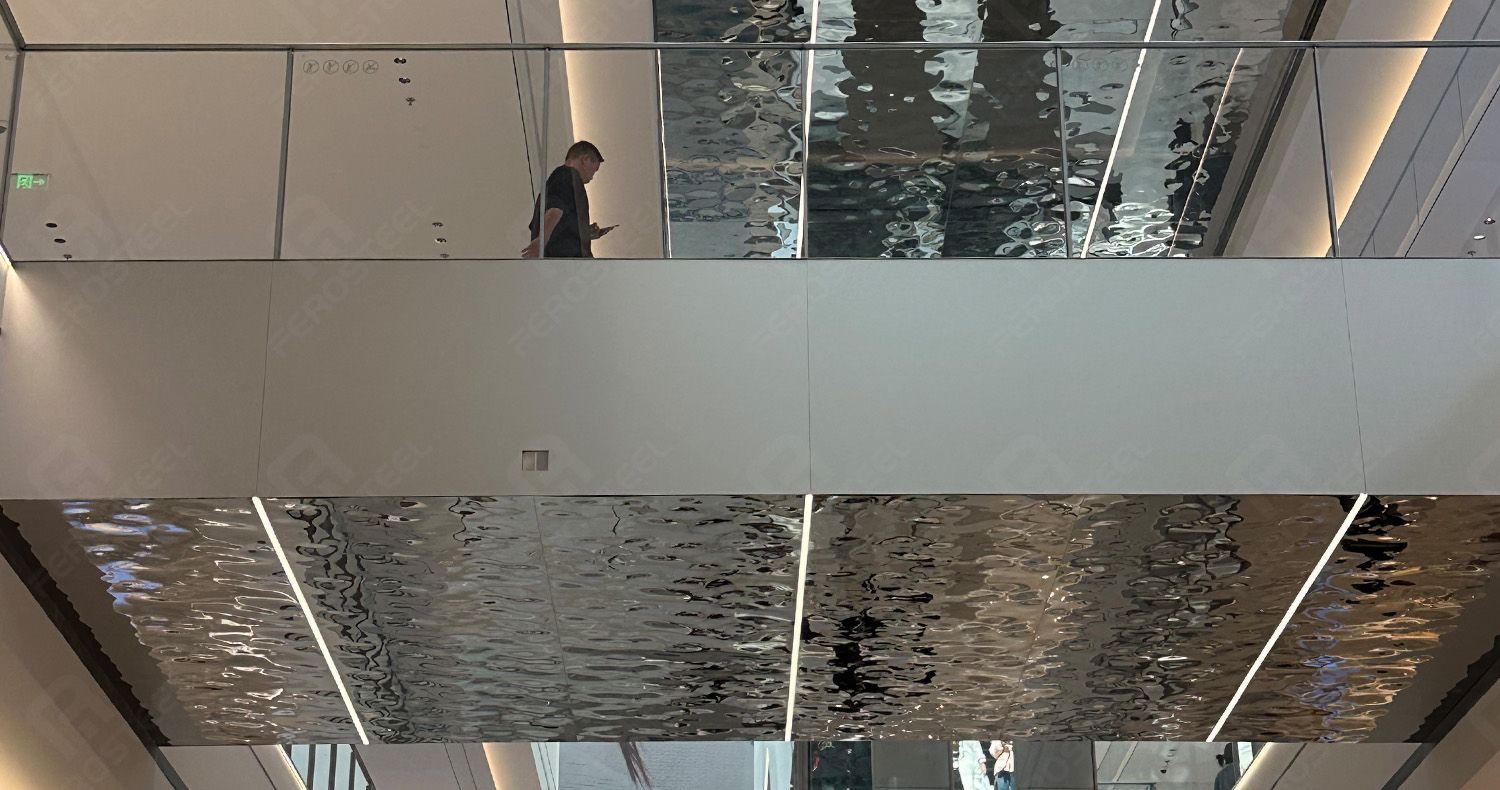
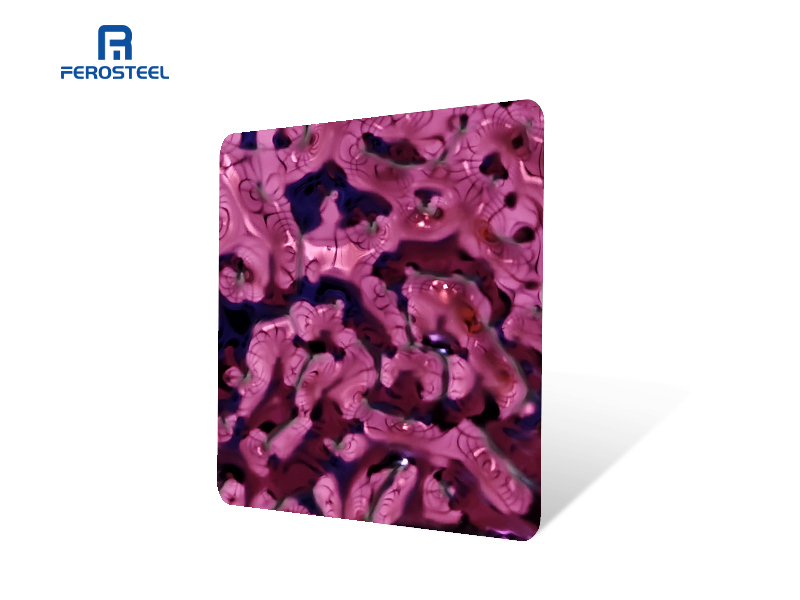
Color is the most immediate language of interior design — and pink, long dismissed as a niche choice, has emerged as one of the most influential hues in contemporary architecture. From boutique hotel lobbies in Milan to luxury retail flagship stores in Tokyo, pink-tone metal surfaces are redefining how designers approach warmth, sophistication, and brand identity. At the intersection of this trend sits a material that combines two of the most sought-after characteristics in decorative metalwork: the fluid, light-dancing surface of a water ripple stainless steel sheet, and the precision-engineered coloration of custom PVD coating.
Unlike traditional paint or anodizing, PVD (Physical Vapor Deposition) delivers a pink finish that is molecularly bonded to the stainless steel substrate — not applied on top of it. The result is a surface that resists scratching, fading, and corrosion while maintaining the unmistakable visual depth that architects and interior designers demand. For projects where a pink metal panel serves as a focal wall, reception desk, elevator interior, or ceiling feature, the combination of water ripple texture and PVD pink coloration creates something that standard materials cannot replicate: a genuinely immersive visual experience that shifts with ambient light and viewing angle.
Ferosteel, as a specialized manufacturer of decorative stainless steel sheets, has refined the custom PVD stainless steel production process to deliver consistent, vibrant pink tones across large-format panels — a technical challenge that separates industrial-grade coating from architectural-grade finishing. What follows is a comprehensive guide for architects, interior designers, and contractors evaluating pink water ripple stainless steel for their next project.
At its core, pink water ripple stainless steel is a two-layer product. The base is a stainless steel sheet — typically grade 304 or 316L — pressed with a water ripple embossing pattern that creates gently undulating ridges across the surface. These ridges capture and scatter light in much the same way as ripples on a pond, producing a dynamic visual effect that changes depending on where the viewer stands. Over this textured base, a PVD (Physical Vapor Deposition) coating is applied in a precisely controlled pink hue.
The water ripple pattern — also referred to as "wave" or "ripple" finish in architectural specifications — achieves its effect through controlled mechanical embossing. Unlike flat PVD-coated sheets, the ripple texture introduces depth and movement. When combined with a pink PVD finish, the interplay between texture and color creates a surface that appears almost liquid. At a glancing angle, the ridges catch warm pink highlights; viewed head-on, the color settles into a more uniform rose tone.
It is critical for specifiers to understand that a pink PVD finish is not paint, powder coating, or laminate film. PVD is a vacuum-deposition process that embeds color at the atomic level. This means the pink surface will not peel, bubble, or delaminate under normal architectural conditions. It also means the finish does not add significant thickness to the sheet — an important consideration when panels must fit into tight joinery or prefabricated framing systems.
PVD coating for decorative stainless steel operates on principles rooted in semiconductor manufacturing and aerospace engineering. Understanding the process helps designers appreciate why custom PVD stainless steel commands a premium over conventional color treatments — and why the investment pays off in longevity.
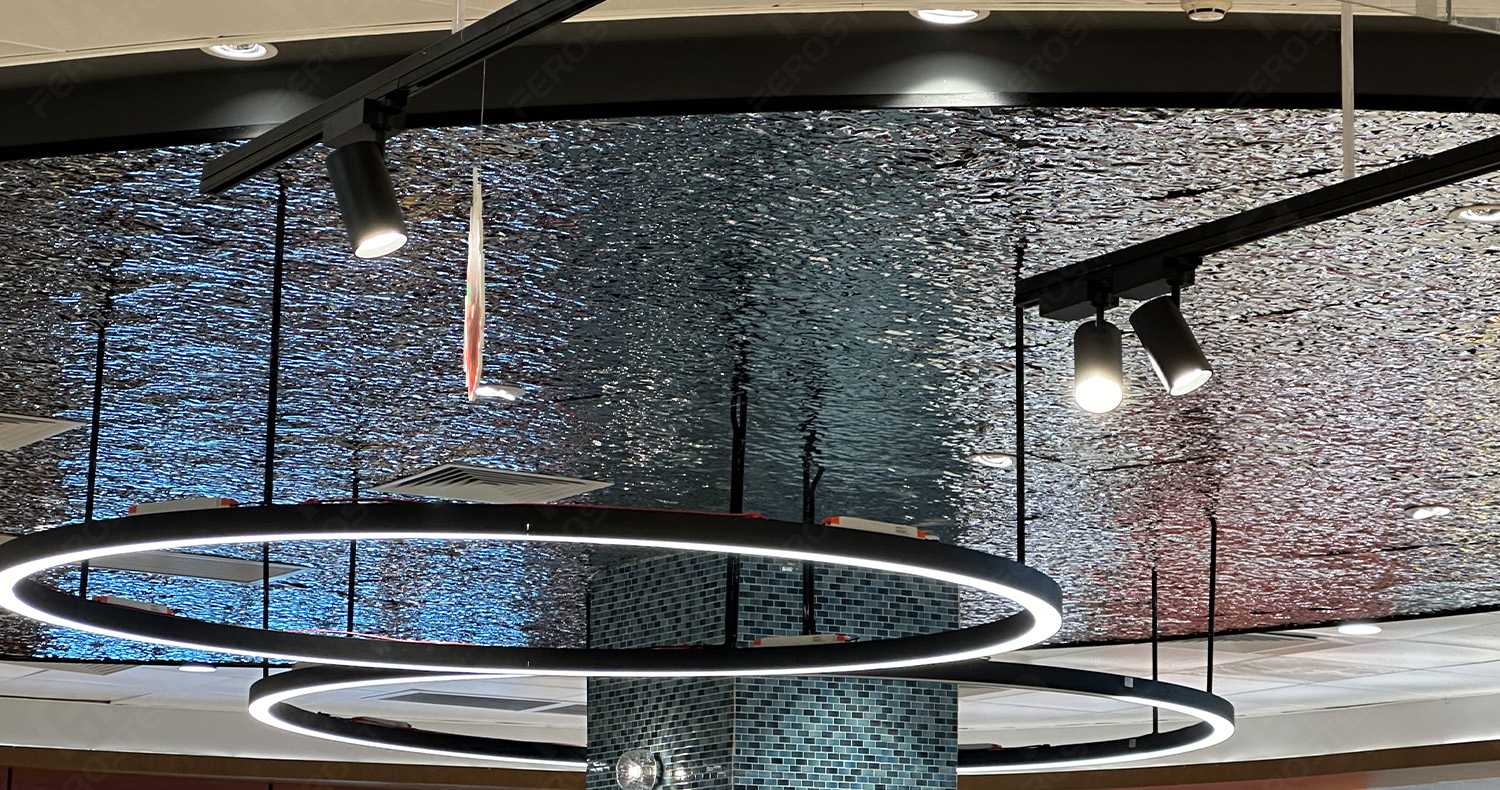
Achieving a uniform pink tone across an entire sheet — and across multiple sheets within a single project — is the hardest part of PVD color control. Slight variations in gas flow, arc current, or chamber temperature can shift the hue toward copper or toward silver. Ferosteel's production protocol includes color-matching against physical master swatches and spectrophotometer verification to ensure batch-to-batch consistency. For projects requiring multiple panels for a single feature wall, this level of control is non-negotiable.
The versatility of a pink metal panel with water ripple texture makes it suitable for a range of architectural and interior contexts. Below are the most common applications, each with specific design considerations.
A pink water ripple feature wall behind a hotel reception desk or corporate lobby instantly signals design intentionality. The ripple pattern adds movement without the busyness of complex geometric patterns, while the pink tone introduces warmth without sacrificing professionalism. For the best effect, specifiers should orient the ripple direction horizontally across the wall — this maximizes light reflection and creates the illusion of a wider space.
Elevator interiors are one of the most scrutinized vertical surfaces in any building. The confined space amplifies every design decision. Water ripple stainless steel in pink PVD transforms what is typically a utilitarian box into a memorable design moment. The ripple texture also has a practical benefit: it is more forgiving of fingerprints and minor surface marks than mirror-finished flat sheets, reducing visible maintenance frequency.
For luxury retail, pink water ripple panels function as display plinths, cash-wrap facades, and fitting-room doors. In high-end restaurants and bars, pink ripple sheets serve as bar-front cladding, column wraps, and ceiling feature panels. The material reflects ambient lighting in ways that enhance the dining or shopping experience — a consideration that hospitality designers consistently rate as high-priority.
At the residential scale, a pink water ripple stainless steel backsplash or bathroom vanity panel introduces a distinctive finish that sets a project apart from conventional tile or stone. When paired with matte black fixtures or warm wood cabinetry, the pink metal creates a balanced palette that feels both modern and inviting.
One of the key advantages of sourcing from a specialized manufacturer is the range of customization available. Standard off-the-shelf products rarely meet the demands of architectural specification, which is why Ferosteel offers comprehensive custom PVD stainless steel options.
| Grade | Best For | Key Property |
|---|---|---|
| ------- | ---------- | -------------- |
| 304 | Interior walls, retail fixtures, residential applications | Excellent corrosion resistance for indoor use; most cost-effective option |
| 316L | Coastal environments, exterior cladding, swimming pool areas | Superior chloride and salt resistance; molybdenum-enhanced formulation |
For most interior design applications, 304-grade provides more than adequate performance. However, projects in coastal locations or areas with high humidity should specify 316L to prevent any risk of tea staining or pitting.
Ferosteel's pink water ripple sheets are available in standard dimensions of 1,219 mm × 2,438 mm (4′ × 8′) and 1,219 mm × 3,048 mm (4′ × 10′), with custom sizing available on request. Thickness options range from 0.6 mm to 1.5 mm, with 0.8 mm and 1.0 mm being the most common selections for wall cladding applications. Thicker gauges (1.2 mm–1.5 mm) are recommended for elevator interiors and high-traffic fixture applications.
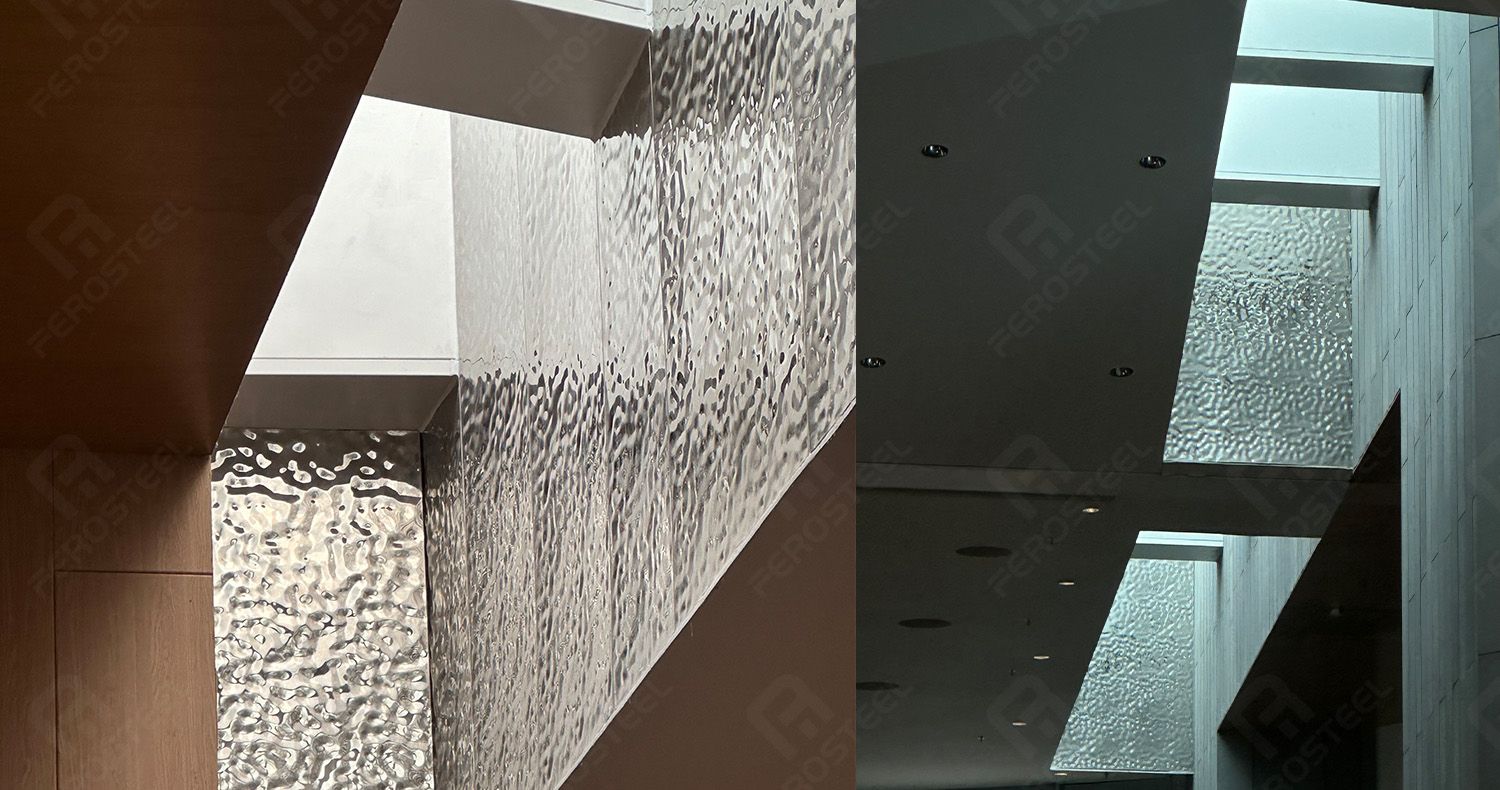
The water ripple pattern is available in multiple wave scales:
The "pink" in PVD coating spans a spectrum from soft blush to deep rose gold. Designers can specify:
Physical sample swatches are available upon request to ensure color accuracy before production.
Choosing the right finish for a decorative metal application requires balancing aesthetics, durability, and budget. The table below compares pink PVD-coated water ripple stainless steel against alternative decorative metal finishes commonly specified in architectural projects.
| Feature | Pink PVD Water Ripple SS | Powder-Coated Metal | Anodized Aluminum | Brushed Stainless Steel (Natural) | Laminated Metal Panel |
|---|---|---|---|---|---|
| --------- | -------------------------- | --------------------- | ------------------- | ---------------------------------- | ------------------------ |
| Color Durability | Excellent — molecular bond resists fading 15+ years | Moderate — prone to chipping and UV fading | Good — but limited color range for pink tones | N/A (no color) | Poor — film peeling risk in high-humidity areas |
| Abrasion Resistance | Very high (ceramic-hard coating) | Moderate | Moderate | High (scratch-hiding brushed texture) | Low — surface film scratches easily |
| Corrosion Resistance | Excellent (316L option for marine environments) | Depends on base metal | Good | Excellent | Depends on base metal |
| Texture & Depth | Dynamic ripple + PVD interplay | Flat or orange-peel texture | Typically flat or brushed | Linear brushed grain only | Printed texture, no real depth |
| Color Consistency | High (spectrophotometer-verified) | Moderate (batch variation) | Good | N/A | Moderate to good |
| Fire Rating | Class A (non-combustible) | Varies by powder formulation | Class A | Class A | Varies — film may be combustible |
| Sustainability | 100% recyclable stainless steel; PVD is VOC-free process | Solvent-based powders may emit VOCs | Energy-intensive anodizing | Fully recyclable | Mixed materials — hard to recycle |
| Cost (Relative) | $$ – $$$ (mid-to-premium) | $ – $$ (economy) | $$ (mid-range) | $ (economy) | $ – $$ (economy-to-mid) |
| Best Application | Feature walls, elevator interiors, luxury retail, hospitality | Budget interior panels, industrial | Light-duty interior trim | Utility and industrial surfaces | Temporary or low-traffic installations |
The comparison makes clear that while pink PVD water ripple stainless steel represents a mid-to-premium investment, it is the only option that simultaneously delivers true pink coloration, dynamic surface texture, architectural-grade durability, and complete recyclability. For permanent installations in high-visibility areas, the cost differential is amortized over decades of maintenance-free performance.
Architects and contractors require hard data before specifying any finish. Below are the key technical parameters for Ferosteel's pink water ripple stainless steel sheets.
| Parameter | Value |
|---|---|
| ----------- | ------- |
| Base Material | SUS 304 / SUS 316L |
| Surface Pattern | Water Ripple (Medium Wave standard) |
| PVD Coating Thickness | 0.3–2.0 μm |
| PVD Coating Hardness | 2,000–3,000 HV (Vickers) |
| Sheet Thickness Range | 0.6 mm – 1.5 mm |
| Standard Sheet Size | 1,219 × 2,438 mm / 1,219 × 3,048 mm |
| Weight (0.8 mm, 4′×8′) | ~19 kg per sheet |
Ferosteel maintains a ΔE tolerance of ≤ 1.5 between production batches for the same pink specification. This means that panels produced weeks apart for the same project will appear visually identical under standard lighting conditions. For large-scale projects requiring phased delivery, this level of control eliminates the need for on-site color blending or re-ordering.
Proper installation and maintenance ensure that pink water ripple sheets perform as designed throughout the building lifecycle.
The pink PVD finish requires remarkably little maintenance:
Yes, but with an important caveat. When exposed to direct weather, you should specify 316L-grade stainless steel rather than standard 304. The 316L grade contains molybdenum, which provides superior resistance to chlorides (salt spray, coastal air, de-icing salts). The pink PVD coating itself is UV-stable and will not fade outdoors, but the underlying metal must be capable of withstanding the environmental conditions. For fully exposed exterior cladding, Ferosteel recommends consulting with their technical team to confirm suitability for your specific location.
PVD pink and electroplated rose gold are fundamentally different technologies. Electroplating deposits a soft metal layer (usually gold-copper alloy) onto the surface through an electrochemical bath — the bond is mechanical, not molecular. This makes electroplated finishes prone to wear, peeling, and color inconsistency over time. PVD, by contrast, creates a ceramic-hard coating that is atomically bonded to the stainless steel. In practice, a PVD pink finish will outlast an electroplated rose gold finish by a factor of 5 to 10 in high-traffic applications. Additionally, PVD is a dry, vacuum-based process with zero chemical effluent — a significant sustainability advantage.
Ferosteel's standard minimum order quantity for custom PVD stainless steel is flexible depending on the project scope. For standard-sized sheets (4′ × 8′ or 4′ × 10′) in a standard pink tone, orders can start from as few as 10–20 sheets. For fully custom dimensions, non-standard pink tones, or specialized embossing depth, the MOQ may be higher. Sample-sized pieces are available for color approval before committing to full production quantities. Contact Ferosteel directly with your project specifications for an accurate quotation.
The short answer: under normal architectural conditions, no. The pink PVD coating achieves a hardness of 2,000–3,000 HV on the Vickers scale — harder than hardened tool steel (typically ~800 HV). This means everyday contact (cleaning, pedestrian traffic, luggage contact) will not scratch the finish. Deliberate abuse — such as keying with a sharp metal object — can mark the surface, but this would damage virtually any decorative finish. The coating will not peel, flake, or delaminate because it is not a surface film; it is integrated into the metal's crystal structure at the atomic level.
Ferosteel provides a physical sample kit with standard pink tone swatches. You select the closest match, and Ferosteel's production team calibrates the PVD chamber parameters to reproduce that exact tone on your water ripple sheets. For projects where an exact brand color match is required (e.g., matching a corporate identity PMS color), Ferosteel can produce custom samples for approval. The process typically requires 5–7 business days for sample production plus shipping time. Once approved, production lead time for the full order is typically 15–25 business days depending on quantity.
Yes to both — with the right specification. The PVD coating is chemically inert and does not off-gas, making it suitable for healthcare environments where indoor air quality is a concern. For food-contact applications (e.g., restaurant bar fronts, buffet counter cladding), the material meets hygiene standards because the non-porous surface does not harbor bacteria. However, for direct food preparation surfaces (where food is placed directly on the panel), standard uncoated 304 stainless steel with a 2B or No.4 finish remains the regulatory standard in most jurisdictions. PVD-coated panels are best used as decorative surfaces that do not come into direct, sustained food contact.
Contact Ferosteel today for free samples, color swatches, and a customized quotation for your next project. Our technical team is ready to assist with specification, color matching, and logistics — whether you need a single feature wall panel or a full building facade of custom PVD stainless steel.
 Office address: 26 Floor, Shibo Financial Center, Fenjiang South Road No.38, Chancheng, Foshan, GuangDong, China
  Phone
: +86 -18024913898
Phone
: +86 -18024913898 Email
: [email protected]
Email
: [email protected]


 IPv6 network supported
 leave a message