A water ripple stainless steel sheet is a decorative embossed metal panel whose surface has been stamped with a flowing, wave-like texture that catches and scatters light across a three-dimensional surface. It is not a coating, not a film, and not a print. It is a permanent mechanical deformation of the steel itself.
Last month, a procurement manager we'll call David sent us a frustrated email. He had spent three weeks comparing water ripple stainless steel sheet suppliers across Alibaba, Made-in-China, and Google. Every factory claimed "high quality" and "competitive price." Every catalog looked the same.
David's project? A 28-floor residential tower in Dubai. Water ripple panels for every elevator interior. And he was two weeks behind schedule — still without a supplier he trusted.
David's problem is not unique. When you search for water ripple stainless steel sheets, you find hundreds of Chinese manufacturers. They all use the same keywords. They all show the same product photos. And for a B2B buyer spending $50,000 to $500,000 on a single order, "they all look the same" is a nightmare.
This guide solves that problem. You'll learn how water ripple stainless steel sheets are made, which material grade suits your project, how PVD coloring works, what determines pricing, and — most critically — how to evaluate a manufacturer so you don't end up with warped panels, inconsistent textures, or a container of rusted sheets.
**Key Takeaways** - Water ripple texture is created by physically stamping stainless steel sheets through hydraulic presses — it is permanent and won't peel, fade, or delaminate - 304 stainless steel works for 90% of indoor applications; 316/316L is non-negotiable for outdoor, coastal, or high-humidity environments - PVD color coating on water ripple sheets can last 10-15 years indoors and withstands 1,000+ hours of salt spray testing per [ASTM B117 standard](https://www.astm.org/b0117-19.html) - The single most underrated factor in supplier selection is export packaging — improper packing causes more project failures than manufacturing defects - Typical factory-direct pricing ranges from $20 to $120 per square meter, driven primarily by material grade, thickness, PVD color, and order volume
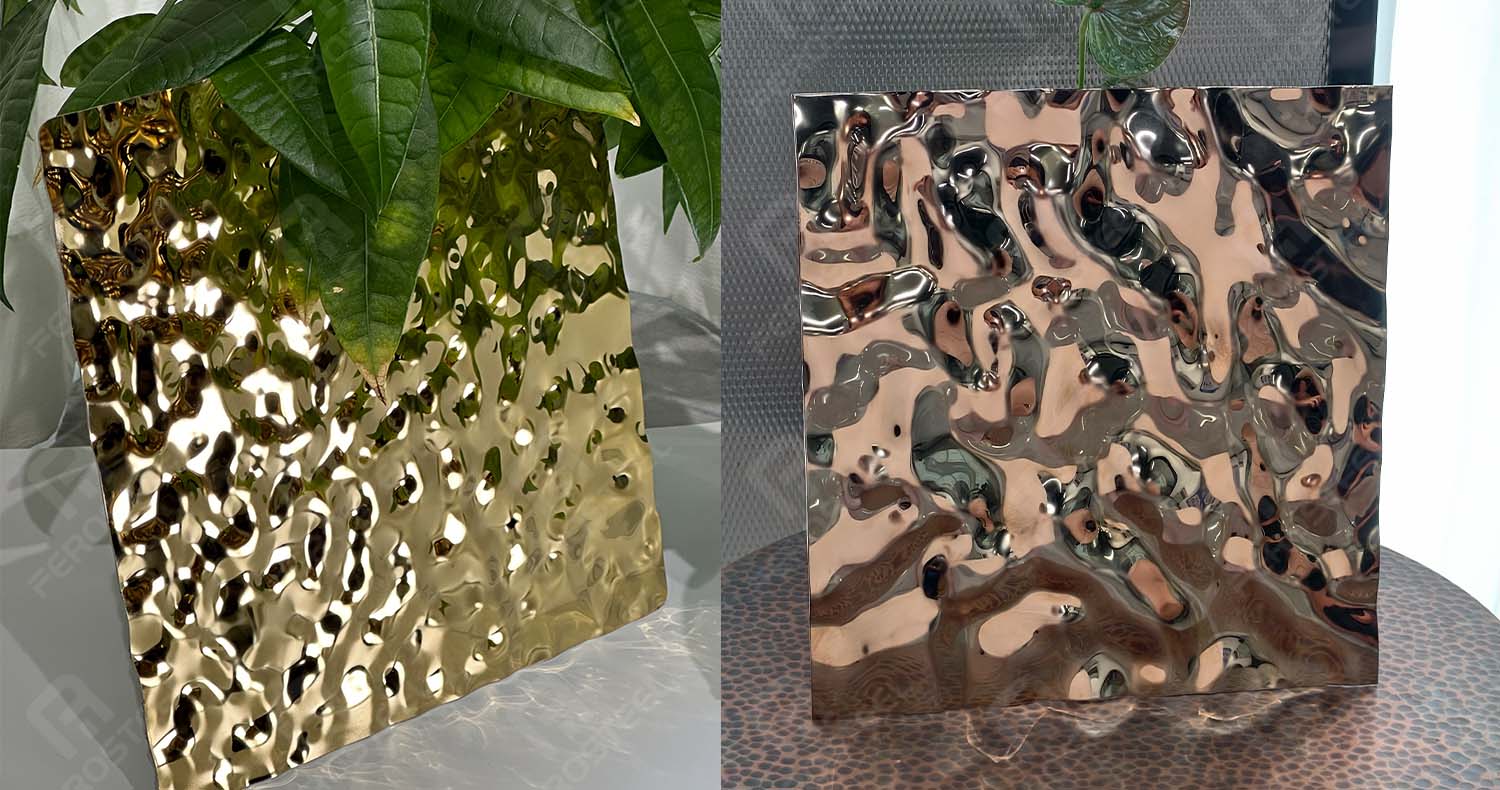
A water ripple stainless steel sheet is exactly what it sounds like: a sheet of stainless steel whose surface has been mechanically stamped to create a pattern that mimics the surface of moving water — soft, undulating waves that interact with light differently depending on your viewing angle. In some markets, these are also referred to as water wave stainless steel sheets.
Unlike printed patterns or applied films, the water ripple texture is a physical deformation of the metal. The waves are pressed into the steel under hundreds of tons of hydraulic force. The pattern is permanent. It won't scratch off. It won't fade under UV light. It won't separate from the substrate because there is no substrate — the pattern is the steel.
The visual effect is striking. Walk past a water ripple wall panel, and the light seems to move across the surface like actual water. Architects and interior designers prize this material for spaces where they want to introduce movement, luxury, and a sense of fluidity — without using actual water features.
Here's how a flat steel sheet becomes a water ripple panel. The process starts with a cold-rolled 2B finish stainless steel sheet — usually 304 or 316 grade. This sheet is fed into a hydraulic stamping press equipped with precision-engraved dies. The upper die, carved with the negative of the ripple pattern, descends onto the sheet with controlled pressure. The metal yields and permanently takes the shape of the die.
Key process variables that determine quality:
• Die precision: High-quality dies are CNC-engraved from hardened tool steel. Worn dies produce shallow, inconsistent ripples.
• Pressure consistency: Hydraulic pressure must be uniform across the entire sheet. Uneven pressure creates patchy texture — a common defect in low-quality production.
• Sheet tension control: The sheet must be held at the correct tension during stamping. Too loose and the pattern distorts; too tight and the sheet may tear at thin gauges.
After stamping, the sheet may undergo PVD (Physical Vapor Deposition) coating for color, followed by a protective PVC film lamination to guard against scratches during handling and transport.
This distinction trips up many first-time buyers, but it matters enormously for project planning.
Directional (Linear) Water Ripple: The waves run in a single direction — usually vertical or horizontal. When you look at the sheet, the ripples flow in parallel lines. This is the most common type and works well for wall cladding and elevator panels where you can control orientation. However, directional patterns create installation constraints: every panel must be installed with the grain running the same way, or the visual mismatch is obvious.
Non-Directional Water Ripple: The wave pattern radiates outward in all directions, like ripples from a stone dropped in water. There is no "grain." Panels can be rotated and installed in any orientation without creating visual seams. Non-directional patterns are harder to manufacture (requiring more complex dies) and cost 10-15% more, but they offer far more design flexibility — especially for ceiling systems and feature walls where panels meet at multiple angles.
For a broader comparison of textured stainless steel patterns — including 5WL, 6WL, and embossed designs — see our [textured stainless steel comparison guide].
Not all water ripple sheets look the same. The pattern is defined by ripple size — the distance between wave peaks — which dramatically changes the visual character of the finished surface.
With a wave pitch of 5-10mm between peaks, small ripple creates a subtle, refined surface. The light reflection is delicate rather than dramatic. From a distance, small ripple reads almost like a brushed texture — you only notice the wave effect up close or when light hits at an angle.
Small ripple works best in: corporate interiors, retail displays, and residential kitchens — anywhere you want texture without theatrical drama.
Medium ripple, with a wave pitch of 15-25mm, is the workhorse of the category. It accounts for 60-70% of all water ripple orders because it strikes the right balance: visible enough to be noticed, subtle enough to avoid overwhelming a space.
This is the pattern you see in most elevator interiors, hotel lobby feature walls, and commercial ceiling installations. When someone says "water ripple stainless steel," medium ripple is usually what they mean.
With wave peaks 30mm or more apart, large ripple makes an unapologetic design statement. The waves are unmistakable from across a room. Light plays dramatically across the surface. This pattern works in spaces with high ceilings and generous proportions — think airport VIP lounges, luxury hotel atriums, or the facade of a flagship retail store.
Large ripple requires thicker base material (at least 0.8mm, ideally 1.0mm+) because the deeper stamping creates more stress on the metal. Using thin material for large ripple patterns risks warping and structural weakness.
*Explore our [complete water ripple pattern collection] with 12+ pattern and color combinations, all available for sampling.*
Here is where a lot of money gets wasted — or saved. Choosing the wrong grade for your application means either overspending on unnecessary corrosion resistance or, far worse, facing a callback when panels start rusting six months after installation.
Imagine you're a project manager for a beachfront hotel in Phuket. The architect has specified water ripple panels for the ocean-facing facade. Your procurement team finds a supplier offering "stainless steel water ripple sheets" at $28/m² — nearly half the price of other quotes.
You place the order.
Eight months after installation, brown rust spots appear along the wave troughs. The culprit? The supplier used 201-grade stainless steel. The entire facade needs replacement. The "savings" have now cost you $180,000 in removal, reorder, and reinstallation — plus a damaged reputation.
304 (also designated as 1.4301 or UNS S30400) is the most widely used stainless steel grade in architectural decoration — and for good reason. Its chemical composition (18-20% chromium, 8-10.5% nickel) provides excellent corrosion resistance in normal atmospheric conditions, good formability for stamping complex textures, and reliable weldability for fabrication.
For water ripple sheets, 304 is the correct choice for:
• Interior wall cladding in commercial buildings, hotels, and retail
• Elevator cabin interiors (the single largest application for water ripple sheets)
• Ceiling panels in controlled indoor environments
• Decorative furniture elements and retail fixtures
• Any indoor space more than 5km from saltwater
The sweet spot: 304 offers 80-90% of the corrosion resistance of 316 at about 60-70% of the material cost.
For a deeper breakdown of 304 vs 316 performance differences — including chemical composition, weldability, and industrial applications — read our [comprehensive 304 vs 316 comparison guide].
316 (1.4401) and its low-carbon variant 316L (1.4404) are the grades you reach for when 304 isn't enough. The critical difference: molybdenum.
316 contains 2-3% molybdenum, an element absent from 304. Molybdenum dramatically improves resistance to chloride corrosion — the kind caused by salt spray, de-icing salts, and industrial pollutants. In standardized salt spray testing per [ASTM B117], 316-grade stainless steel with PVD coating can withstand 1,000+ hours without showing corrosion. 304 begins showing pitting at 200-500 hours under the same conditions.
Use 316/316L when your project involves:
• Building facades and curtain walls exposed to weather
• Coastal projects within 5km of saltwater
• Swimming pool areas, spas, and humid indoor environments
• Outdoor sculptures and architectural features
• High-pollution urban environments with acid rain risk
The cost premium for 316 is real — 30-40% more than 304 for the raw material. But as the Phuket hotel story illustrates, the real cost comparison isn't 304 vs 316; it's "doing it once vs doing it twice."
*The [British Stainless Steel Association] provides detailed guidance on stainless steel selection for building exteriors, covering grade selection, finish durability, and maintenance requirements.*
201 stainless steel (1.4372) exists in the market and you will see it offered by some manufacturers at attractive prices. It has lower nickel content (3.5-5.5% vs 304's 8-10.5%) and higher manganese, which reduces cost but also reduces corrosion resistance and workability.
For water ripple decorative sheets, 201 is generally not recommended for any application where appearance matters beyond the short term. It is more prone to surface rust, more difficult to form clean ripple patterns (higher work-hardening rate), and lacks the luster that makes water ripple sheets visually compelling in the first place.
The one legitimate use case: temporary exhibition displays or short-term retail pop-ups where the installation will be removed within 3-6 months and budget is the absolute priority. For anything permanent or client-facing, spend the extra $8-15/m² for 304.
|
Project Type
|
Recommended Grade
|
Why
|
|
Indoor elevator cabin
|
304 |
Controlled environment, cost-effective
|
|
Hotel lobby feature wall
|
304 |
Indoor, low corrosion risk
|
|
Shopping mall ceiling
|
304 |
Indoor, standard atmospheric conditions
|
|
Building exteriorfacade inland
|
316L |
Weather exposure, UV, rain
|
|
Coastal building within5kmofsea
|
316L |
Salt spray _ non-negotiable
|
|
Swimming pool surround
|
316L |
Chlorine + humidity
|
|
Outdoor sculpture/artwork
|
316L |
Continuous weather exposure
|
|
Temporary exhibition booth
|
201 acceptable |
Short lifespan, budget-critical
|
The natural color of stainless steel is silver-gray. Beautiful in its own right, but limiting. PVD (Physical Vapor Deposition) coloring transforms water ripple sheets from a single-look material into a palette of possibilities — and this is where the material becomes genuinely exciting for designers.
The seven most specified PVD colors for water ripple stainless steel sheets are:
• Gold (#PVD-GD): The most popular PVD color globally, especially in Middle Eastern and South Asian markets. Creates warmth and perceived luxury. Works exceptionally well with warm interior lighting.
• Rose Gold (#PVD-RG): Growing rapidly in popularity — particularly in hospitality and high-end residential. The copper-pink tone softens the industrial feel of stainless steel while maintaining sophistication.
• Champagne (#PVD-CH): A subtler alternative to gold. Popular in European commercial interiors where overt gold reads as excessive.
• Black (#PVD-BK): Creates dramatic contrast. Black water ripple panels absorb light in the wave troughs and reflect it on the peaks, producing a sculptural effect unlike any other finish.
• Bronze (#PVD-BZ): A warm, earthy metallic that works well in spaces with natural materials — timber, stone, leather.
• Blue (#PVD-BL): A niche but striking option. Blue PVD on water ripple creates an actual "water" visual association that designers use in aquatic centers, spa facilities, and ocean-themed hospitality.
• Silver (Natural): Not technically a PVD color — this is the natural stainless steel finish, often with a protective clear coat. Still the most specified option for corporate and minimalist projects.
For a warm metallic aesthetic that pairs with natural materials, see our [copper PVD water ripple sheets in 304 and 316 grade]— a popular choice for hospitality projects.
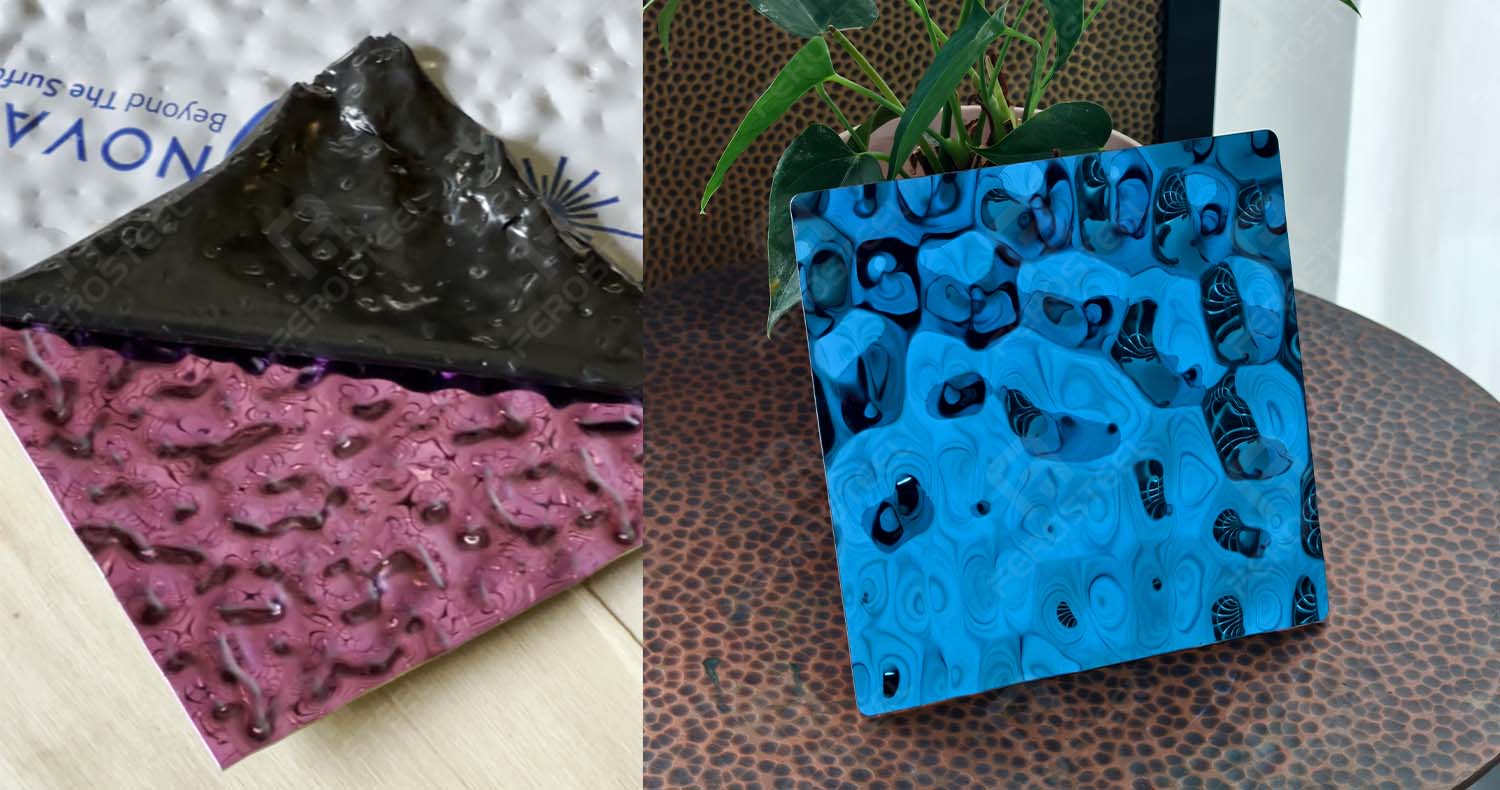
PVD is a vacuum-based process. The stainless steel sheet is placed in a vacuum chamber, and the coating material — titanium nitride (for gold tones), zirconium nitride, or chromium nitride — is vaporized and deposited onto the surface at the atomic level. Unlike paint or electroplating, PVD forms a molecular bond with the steel substrate.
What this means for durability:
• Indoor lifespan: 10-15 years without visible fading or color shift in normal commercial environments
• Scratch resistance: Significantly harder than the base stainless steel — PVD coatings achieve 2,000-3,000 HV (Vickers hardness), compared to ~200 HV for uncoated 304
• Salt spray performance: Quality PVD coatings withstand 1,000+ hours of neutral salt spray testing per ASTM B117 without corrosion
• UV stability: Unlike organic coatings, PVD does not degrade under ultraviolet light — the color won't yellow or chalk outdoors
The catch: PVD quality varies enormously between manufacturers. Poor process control results in color inconsistency between batches, thin spots, and premature failure. This is exactly why the supplier selection chapter (below) matters so much.
For a deeper dive into PVD technology and color selection, read our [PVD coating process guide].
The global standard for water ripple stainless steel sheets follows the construction industry's imperial legacy:
• 4'×8' (1219mm × 2438mm) — The most common size worldwide. Fits standard container loading, standard elevator cabin dimensions, and common wall panel modules. If you're not sure what size to order, start here.
• 4'×10' (1219mm × 3048mm) — Increasingly popular for feature walls and ceiling systems where fewer seams are desired. Requires more careful handling due to length.
• Custom sizes — Most established manufacturers can produce sheets up to 1,500mm wide and 4,000mm long, depending on their press bed dimensions. Non-standard sizing adds 10-15% to the per-square-meter price and may require custom die setup.
Water ripple sheets are produced in thicknesses from 0.3mm to 3.0mm. Your choice depends on the application:
|
Thickness
|
Best For
|
Notes
|
|
0.3mm - 0.5mm
|
Lightweight ceiling panels, decorative overlays
|
Low structural strength; must be bonded to a
substrate
|
|
0.6 - 0.8mm |
Wall cladding, elevator cabin interiors
|
The “standard” range _ good balance of
formability and rigidity
|
|
1.0 - 1.5mm |
Feature walls, high-traffic areas, exterior cladding
|
Excellent rigidity; handles large ripple patterns
well
|
The most commonly ordered thickness for interior wall cladding and elevator panels is 0.8mm, which provides sufficient rigidity for most installations without unnecessary weight or material cost.
Elevator interiors are, by far, the single largest application for water ripple stainless steel sheets. The reasons are practical as well as aesthetic: elevator cabins are compact, well-lit boxes where every surface is seen at close range. A flat mirror-finish panel in an elevator shows every fingerprint, scratch, and smudge. A water ripple panel disguises all of that — the texture scatters reflections and hides minor surface imperfections.
Picture an architect named Mei, specifying materials for a 42-story office tower in Singapore. She has eight elevator cabins to outfit. The developer wants a "premium" feel but the maintenance team has vetoed mirror panels (fingerprint nightmare) and dark wood veneer (scratch-prone). Mei specifies medium ripple, champagne PVD, 304-grade stainless steel — and every stakeholder signs off on the first sample. The ripple pattern reads as luxurious, hides daily wear, and requires nothing more than occasional wiping with a microfiber cloth.
*Browse our [stainless steel elevator interior panels] for your next project.*
Water ripple feature walls have become a signature element in hotel lobbies, corporate headquarters, and luxury retail. The material creates what designers call a "living surface" — a wall that changes as you move past it, with light shifting across the wave peaks.
The key specification consideration for wall cladding is panel jointing. With directional ripple, every panel must be installed with the wave grain running consistently. A single rotated panel creates an immediately visible discontinuity. This is why many designers now specify non-directional ripple for large wall installations — the flexibility is worth the premium.
Water ripple stainless steel ceilings are a defining trend in commercial interior design. Unlike traditional ceiling materials — acoustic tiles, gypsum board, mineral fiber — a water ripple metal ceiling introduces reflectivity, depth, and a sense of height. The wave texture catches downlights and creates a dappled reflection effect across the ceiling plane.
We've documented a real-world water ripple ceiling installation where the wave texture transforms an entire lobby space.
Weight is the critical factor for ceiling applications. At 0.5-0.6mm thickness, a water ripple sheet weighs 4-5 kg/m² — comparable to heavy acoustic tile systems. Suspension frameworks must be engineered accordingly. For spans over 1,200mm, additional support rails are recommended to prevent sagging.
Exterior water ripple facades are less common than interior applications — but when executed well, they are unforgettable. The large-scale wave pattern creates a kinetic facade effect: as the sun moves across the sky, the building's surface appears to shift and flow.
For any exterior application, three requirements are non-negotiable:
• 316L grade minimum — 304 will develop tea staining within 12-24 months of weather exposure
• Minimum 1.2mm thickness — wind loads on exterior panels demand structural integrity
• PVD coating with documented salt spray test results — verify, don't trust
The hospitality sector has embraced water ripple stainless steel with particular enthusiasm. The material appears in hotel reception desks, bar fronts, column cladding, restaurant feature walls, and spa reception areas. The common thread: these are spaces where the client wants guests to feel they are somewhere special — and a rippling, light-catching metal surface signals "this is not an ordinary room."
Beyond architectural surfaces, water ripple sheets are increasingly used in custom furniture: bar tops, table surfaces, cabinet fronts, and reception counters. At furniture scale, the ripple pattern creates a tactile as well as visual experience — people want to touch it. This makes the material particularly effective in retail environments where physical engagement drives purchase decisions.
**If you're sourcing water ripple sheets for a large-scale project, [request a free sample and quote]— we'll ship sample swatches within 5 working days.**
This chapter is why this guide exists. Every other topic we've covered — material grades, PVD colors, ripple patterns — is discussed by at least some competitors. But a systematic framework for evaluating water ripple stainless steel sheet manufacturers? As of 2026, virtually no one in the SERP top 10 covers it.
Yet for a B2B buyer, this is the decision that determines whether your project succeeds or fails.
When you're sourcing water ripple sheets from China — and the vast majority of global production comes from the Foshan stainless steel manufacturing cluster — you need to verify what you cannot see from a website.
Minimum factory criteria that matter:
• Factory size: A facility under 3,000m² is unlikely to have dedicated production lines for embossed/stamped decorative sheets. Look for 5,000m²+ with visible press equipment.
• In-house stamping presses: Many "manufacturers" are actually trading companies that outsource stamping to third-party workshops. Ask for dated photos of their press line with their company signage visible in the frame.
• In-house PVD coating line: Color consistency depends on controlling the PVD process. If a supplier outsources PVD, you're adding a quality variable they cannot control.
• QC laboratory: Does the factory have in-house testing equipment — salt spray chamber, coating thickness gauge, spectrophotometer? If they send samples to an external lab for every test, turnaround times will be slow and quality control will be reactive, not proactive.
Certifications are not a guarantee of quality, but their absence is a reliable warning sign.
• ISO 9001:2015: The baseline. Any serious manufacturer should have this. Verify the certificate number on the issuing body's website — certificates can be forged.
• SGS / TÜV / Bureau Veritas product testing: Look for third-party test reports on the specific product — not just the raw material. A mill test report (MTR) for the base stainless steel coil is not the same as a product test on the finished water ripple sheet.
• ASTM A240 / A480 compliance: For buyers in North America and the Middle East, ASTM standard compliance is often a contractual requirement. Confirm that the manufacturer regularly produces to ASTM specifications, not just Chinese GB standards.
• ISO 14001 (environmental) and ISO 45001 (occupational health & safety): These signal a professionally managed operation. Not mandatory, but a strong positive indicator.
Water ripple stainless steel is rarely an off-the-shelf purchase. Most projects require some level of customization:
• Custom sheet dimensions: Non-standard sizes to match project module dimensions
• Custom ripple patterns: Proprietary wave pitch, depth, or non-directional configurations
• Custom PVD colors: Color matching to a provided sample or Pantone reference
• Edge processing: Laser cutting, bending, V-grooving, or folded edges for specific installation systems
A capable manufacturer should be able to provide a custom sample within 7-10 working days of receiving your specification. If the lead time for a custom sample stretches beyond three weeks, that's a signal that the supplier is coordinating multiple subcontractors — and you'll face the same coordination delays on your production order.
Here's a truth most sourcing guides won't tell you:
 Office address: 26 Floor, Shibo Financial Center, Fenjiang South Road No.38, Chancheng, Foshan, GuangDong, China
  Phone
: +86 -18024913898
Phone
: +86 -18024913898 Email
: [email protected]
Email
: [email protected]


 IPv6 network supported
 leave a message